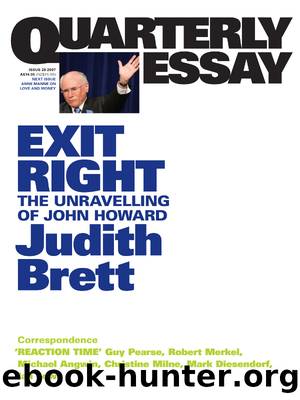
Quarterly Essay 28 Exit Right: The Unravelling of John Howard by Judith Brett
Author:Judith Brett [Brett, Judith]
Language: eng
Format: epub
Tags: Leadership, Political Ideologies, Political Parties, Political Science, World, Political Process, Australian & Oceanian, Writing, Conservatism & Liberalism, Politics
ISBN: 9781921825279
Google: dd39AAAAQBAJ
Goodreads: 18294490
Publisher: Black Inc.
Published: 2007-12-14T00:00:00+00:00
REACTION
TIME
Correspondence
Guy Pearse
I was at the National Press Club in 2005 when Ian Lowe gave his prescient warning about the dangers of Australia proceeding further down the nuclear path, and I recall his speech going against the grain for many people there. It wasnât that they disagreed with what Lowe was saying â they just thought he was jumping at shadows. Nuclear power was not high on the political agenda, let alone the greenhouse policy agenda, in Australia at the time. Only a year before, the Howard government had made clear in its Energy White Paper that nuclear power was not happening in Australia: âUse of uranium reserves raises cost, safety and disposal issues in power generation ⦠Australia is not contemplating the domestic use of nuclear power.â Senior ministers, including Ian Macfarlane and Nick Minchin, dismissed nuclear power as something that would never be viable â not even for a hundred years. But Ian Lowe saw something else coming â the inevitability that climate change would be taken seriously in Australia, and the political irresistibility of nuclear power once that occurred.
When Howard had his nuclear conversion, most observers failed to take it seriously. Many in the business community, the environmental movement, political and bureaucratic circles were dismissive when John Howard appeared to back-flip on nuclear power in 2006 after a trip to Washington. For them, Howardâs agenda was simply wedging Labor on uranium mining and facilitating an expansion of that industry. There were no serious plans to support uranium enrichment, to make Australia the worldâs radioactive waste dump, and no one really thought nuclear power would ever be viable in Australia. As for a sceptic prime minister who had twice blocked emissions trading suddenly embracing a carbon price high enough to make nuclear power competitive in the low-emissions energy market? The prospect seemed remote to almost everyone. It would cut across the governmentâs whole approach to climate change and its heavy focus on âclean coal.â Or so most people thought.
However, most observers missed a few things. They failed to appreciate the powerful influence of the various HowardâBush tête-à -têtes on climate change and energy policy and the consistency of a pro-nuclear stance with the approach locked in at these meetings. They failed to appreciate the tenacious ideological support for the nuclear industry among neo-liberals within the Liberal Party. And they failed to notice the confluence of interests between many in the fossil-fuel and uranium industries. Nor did they distinguish between the short and long term. Had more people been more mindful of these factors, they would have seen Howardâs nuclear conversion coming and taken it far more seriously.
John Howard has had a symbiotic relationship with the Bush administration in general, and his climate-change response largely mirrored that of his US counterpart. As I describe in my book High and Dry, the first meeting between the two men on the eve of the September 11 terrorist attacks in Washington and New York was a decisive moment. Not only did going through something
Download
This site does not store any files on its server. We only index and link to content provided by other sites. Please contact the content providers to delete copyright contents if any and email us, we'll remove relevant links or contents immediately.
| Anthropology | Archaeology |
| Philosophy | Politics & Government |
| Social Sciences | Sociology |
| Women's Studies |
The Secret History by Donna Tartt(19088)
The Social Justice Warrior Handbook by Lisa De Pasquale(12190)
Thirteen Reasons Why by Jay Asher(8909)
This Is How You Lose Her by Junot Diaz(6886)
Weapons of Math Destruction by Cathy O'Neil(6279)
Zero to One by Peter Thiel(5802)
Beartown by Fredrik Backman(5754)
The Myth of the Strong Leader by Archie Brown(5507)
The Fire Next Time by James Baldwin(5444)
How Democracies Die by Steven Levitsky & Daniel Ziblatt(5218)
Promise Me, Dad by Joe Biden(5153)
Stone's Rules by Roger Stone(5087)
A Higher Loyalty: Truth, Lies, and Leadership by James Comey(4963)
100 Deadly Skills by Clint Emerson(4925)
Rise and Kill First by Ronen Bergman(4788)
Secrecy World by Jake Bernstein(4753)
The David Icke Guide to the Global Conspiracy (and how to end it) by David Icke(4718)
The Farm by Tom Rob Smith(4509)
The Doomsday Machine by Daniel Ellsberg(4490)
